

Adelaide’s Prodigy and the World’s Greatest Living Mathematician
Terence Tao is often called the “Mozart of Mathematics,” a prodigy whose brilliance has reshaped the boundaries of mathematical thought. Born in Adelaide, Australia, Tao has become a global icon in mathematics, widely regarded as the greatest living mathematician. His journey from a gifted child in South Australia to a world-renowned professor at UCLA is an exceptional story. A story of talent, relentless curiosity, and the enduring influence of family and place.
The Roots: Family and Early Life in Adelaide
Terence Tao was born on July 17, 1975, in Adelaide—a city with a remarkable history of nurturing intellectual giants. Adelaide is also the birthplace of Australia’s first two Nobel laureates. William and Lawrence Bragg, who won the Nobel Prize in Physics in 1915. Like the Braggs, Tao’s early promise was unmistakable, and his achievements would soon echo far beyond his hometown.
Tao’s parents, Billy Tao and Grace Leong, both migrated from Hong Kong. They met at the University of Hong Kong before settling in Adelaide. Billy, born in Shanghai, pursued medicine, while Grace, a Hong Kong native of Cantonese descent, earned first-class honours in mathematics and physics. It’s clear that the seeds of Terence’s genius were sown in a home where intellectual curiosity and academic achievement were valued.
The Tao family’s story is one of migration and aspiration. Adelaide, rather than the more typical destinations of North America or Europe, became the setting for their children’s formative years. Terence’s two younger brothers, Trevor and Nigel, have also distinguished themselves. Trevor as a Chess International Master working in a specialized field for Australia’s Defence Department. Nigel with a prominent technology company in Sydney. The Tao family’s collective achievements are a testament to the nurturing environment they found in Adelaide.
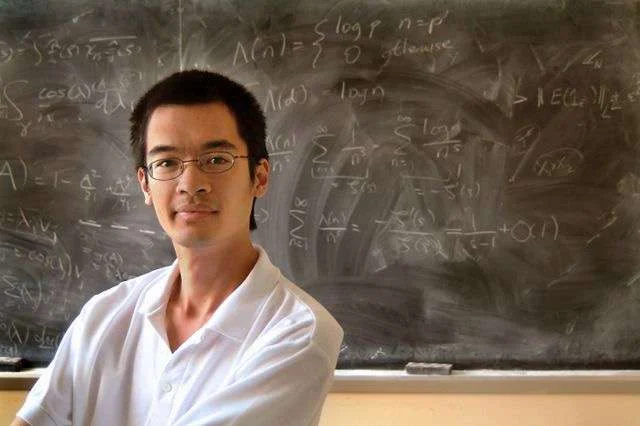
A Prodigy Emerges
From a young age, Terence Tao’s mathematical abilities were extraordinary. At just eight years old, he scored 760 on the SAT math section. An achievement that placed him among only three children worldwide under nine to do so, according to the Johns Hopkins Study of Exceptional Talent. Julian Stanley, director of the Study of Mathematically Precocious Youth, once remarked that Tao had “the greatest mathematical reasoning ability he had found in years of intensive searching.”
Tao’s prodigious talent soon found a stage on the international scene. At age ten, he became Australia’s youngest participant in the International Mathematical Olympiad. Competing from 1986 to 1988 and winning bronze, silver, and gold medals in consecutive years. By sixteen, he had completed both his bachelor’s and master’s degrees in mathematics at Flinders University in Adelaide.
The Path to Global Prominence
In 1992, Tao received a Fulbright Scholarship to pursue doctoral research at Princeton University. He completed his PhD at just 21. An achievement that marked the beginning of his meteoric rise in the mathematical world. By then, it was clear that Australia had produced a mind of rare genius. One that would inevitably find its greatest opportunities abroad.
Australia and Adelaide recognized Tao’s extraordinary potential. There was a sense of pride, rather than regret, as he moved to the global stage. The country’s academic community understood that Tao’s future lay in the international centers of mathematical research. Particularly in the United States. Still, there remains a hope that one day he might return to his city of birth. Much as Nobel laureate J.M. Coetzee, the celebrated author, chose to make Adelaide his home.
Life and Career in the United States
After earning his PhD, Tao joined the faculty at the University of California, Los Angeles (UCLA). Where he was appointed a full professor at the astonishing age of 24—the youngest in the institution’s history. Today, he holds the James and Carol Collins Chair in Mathematics at UCLA. He has authored or co-authored over 300 research papers, remaining at the forefront of mathematical research.
Tao’s research interests are remarkably broad. Spanning harmonic analysis, partial differential equations, algebraic and arithmetic combinatorics, geometric combinatorics, probability theory, compressed sensing, and analytic number theory. His work is characterized by deep insights. A rare ability to connect seemingly disparate areas of mathematics, often solving problems that had resisted progress for decades.
Beyond his professional achievements, Tao’s personal life is a testament to the balance he maintains between work and family. He is married to Laura, an electrical engineer at NASA’s Jet Propulsion Laboratory, and together they have two children. Despite his towering intellect, those who know Tao describe him as humble and approachable. And deeply committed to nurturing the next generation of mathematicians.
The Fields Medal and Global Recognition
In 2006, at the age of 31, Terence Tao was awarded the Fields Medal. The highest honor in mathematics, often described as the Nobel Prize of the field. The Fields Medal is awarded every four years to mathematicians under 40. Recognizing outstanding achievements and the promise of future contributions. Tao’s citation highlighted his “contributions to partial differential equations, combinatorics, harmonic analysis and additive number theory. Areas in which his work has had a transformative impact.
Tao’s recognition brought pride not only to Australia but to the entire mathematical community. He was the first UCLA faculty member to receive the Fields Medal. And his achievements have inspired countless young mathematicians around the world. In 2018, Australia celebrated another Fields Medalist. Akshay Venkatesh, who, like Tao, completed his undergraduate studies in Perth at an exceptionally young age. Before moving to the United States to pursue advanced research.
The Tao Effect: A Lasting Legacy
Terence Tao’s influence extends far beyond his research papers and awards. He is a prolific mentor, guiding students and young researchers with the same generosity and clarity that characterize his mathematical work. His blog, books, and lectures are widely regarded as models of clear and insightful exposition, making advanced mathematics accessible to a broad audience.
Tao’s approach to problem-solving is both creative and rigorous. He is known for tackling some of the most challenging problems in mathematics. Often making breakthroughs by drawing connections across different fields. His work on the Green-Tao theorem, which proved the existence of arbitrarily long arithmetic progressions of prime numbers, is just one example of his ability to solve problems that had stymied mathematicians for generations.
Despite his global stature, Tao remains deeply connected to his roots. He often speaks fondly of his upbringing in Adelaide and the support he received from his family, teachers, and community. His story is a reminder that world-changing talent can emerge from anywhere. And that nurturing environments, both at home and in society, are crucial to unlocking human potential.
Inspiring the Next Generation
Tao’s journey from Adelaide to the pinnacle of mathematics serves as an inspiration to students and educators alike. His life demonstrates that early talent, when recognized and supported, can flourish into extraordinary achievement. It also underscores the importance of openness. Both in sharing talent with the world and in welcoming the contributions of others.
Australia’s willingness to support Tao’s international ambitions reflects a broader understanding that knowledge knows no borders. While the country takes pride in his achievements, it also celebrates the global nature of scientific progress. Tao’s story is a testament to the power of curiosity, perseverance, and the enduring value of intellectual community.
Conclusion: The Enduring Impact of Terence Tao
Terence Tao’s life and work embody the highest ideals of mathematics: creativity, rigor, and a passion for discovery. From his early days as a prodigy in Adelaide to his current role as a leader in the global mathematical community, Tao has continually pushed the boundaries of what is possible. His achievements have brought honor to his hometown, his adopted country, and to the field of mathematics itself.
As the world continues to grapple with complex challenges, the example set by Terence Tao—of brilliance matched by humility, and individual achievement balanced by a commitment to the common good. Which remains more relevant than ever. Whether or not he returns to Adelaide, his legacy is secure. A testament to the transformative power of talent, opportunity, and the enduring pursuit of knowledge.