
Rediscovering Rome’s Hidden Gem: The Church of Sant’ Ignazio di Loyola
Church of Sant’ Ignazio di Loyola is unusual. It is not one of the more notable churches of Rome, mentioned in any tourist literature that we came across. It is however special.
Rome is a city renowned for its grand basilicas, ancient ruins, and world-famous art. Yet, tucked away from the well-trodden tourist paths lies a masterpiece. The Church of Sant’ Ignazio di Loyola.
Unlike the bustling crowds at St. Peter’s Basilica or the Pantheon, this church offers a quieter, yet equally awe-inspiring encounter with Rome’s artistic and spiritual heritage.
An Unexpected Discovery
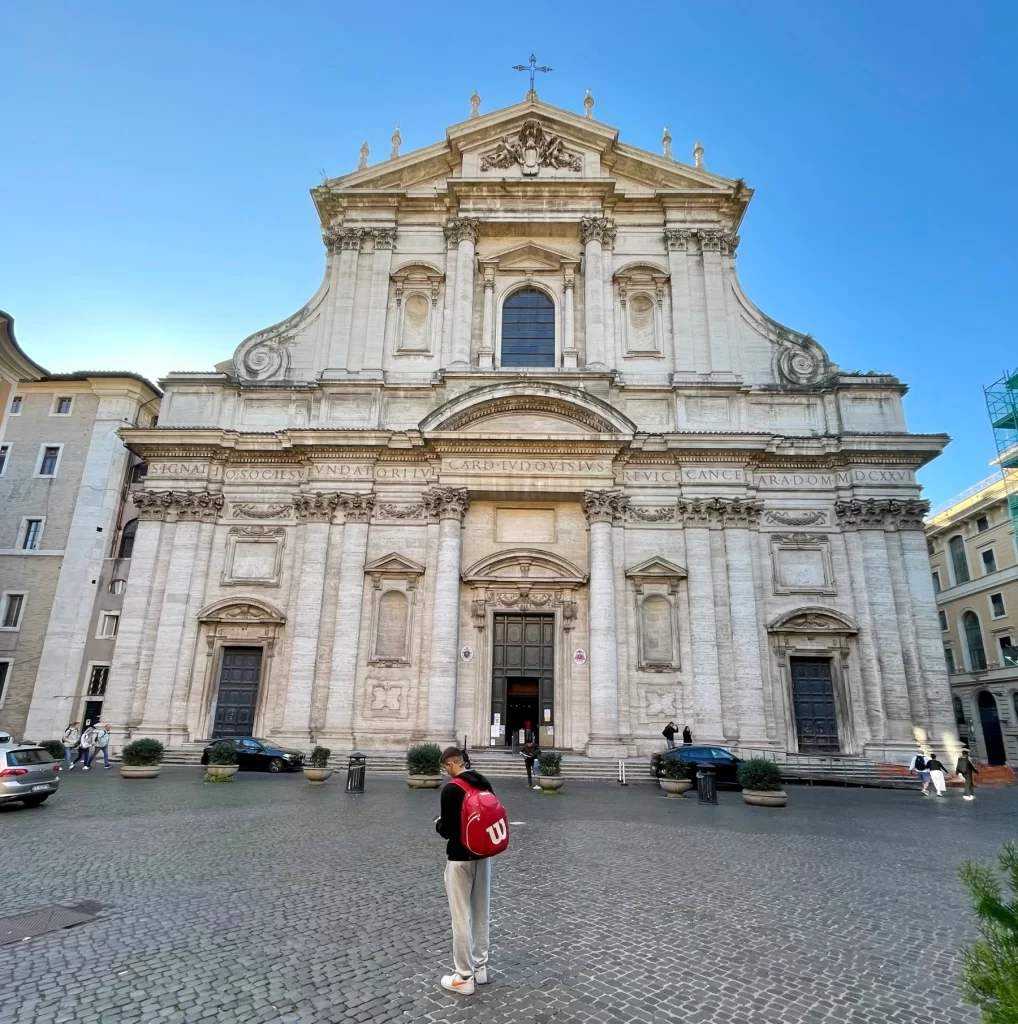
My journey to Sant’Ignazio di Loyola began by chance. As a casual explorer of Rome’s architectural wonders, I didn’t expect to be captivated by a church. A church not featured on the main tourist itineraries.
Early one morning, while navigating the city’s winding alleys en route to the Pantheon, I stumbled upon a modest piazza. There, facing the square, stood a church with an unassuming façade. Curiosity got the better of me. I resolved to return later, after my planned visit to the Pantheon.
First Impressions: A Hidden Marvel
Upon entering Sant’ Ignazio di Loyola, I was greeted by a small crowd clustered around a peculiar sight. A large mirror, angled upwards at 45 degrees, reflecting the church’s magnificent ceiling. The scene was unlike anything I had encountered in Rome’s more famous churches.
The fresco above was breathtaking. Rivaling even the Sistine Chapel in its artistry, yet imbued with a unique character I couldn’t immediately define.
What struck me most was the absence of the long queues that snaked outside Rome’s other major attractions. Here was a church filled with beauty and history, yet largely undiscovered by the masses. It made me wonder how many other hidden treasures Rome might be keeping secret.
A Return Visit and a Growing Fascination
Later that evening, I returned to find the church bustling with visitors who clearly knew of its reputation. The Church of Sant’ Ignazio di Loyola, or Sant’ Ignazio di Loyola in Campo Marzio, is dedicated to Ignatius of Loyola. The founder of the Society of Jesus—the Jesuit Order. Construction began in 1626 and concluded in 1650, replacing an earlier church completed in 1567.
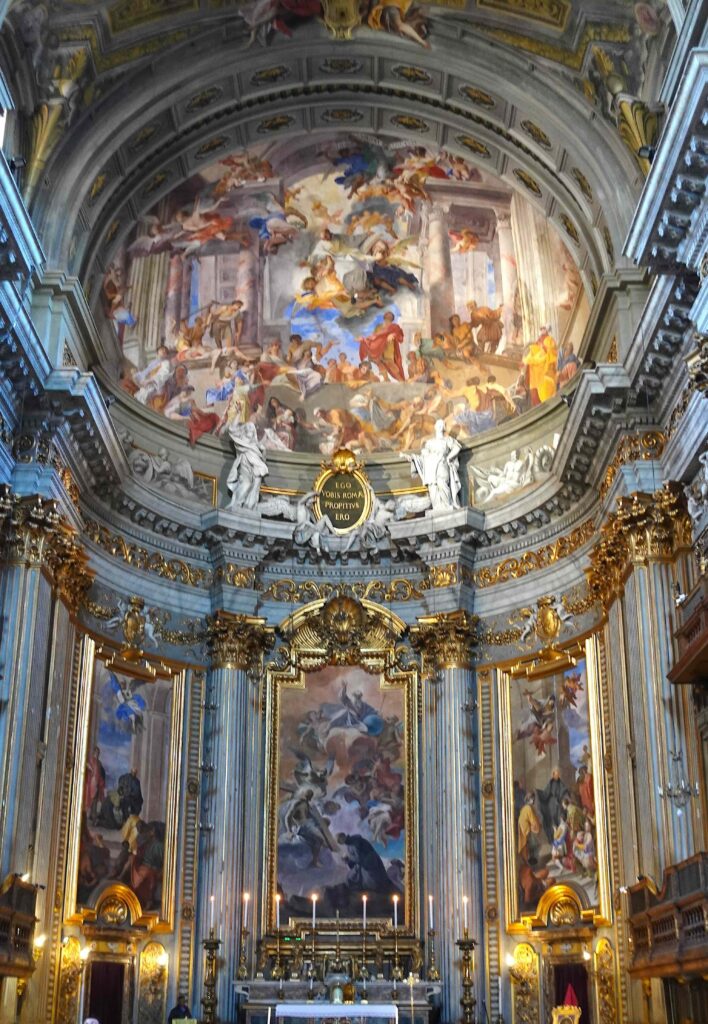
The church’s most extraordinary features owe their existence amazingly to a lack of funds. In 1642, the builders ran out of money. They could not afford to construct a dome—a staple of grand Roman churches. Enter Andrea Pozzo, a Jesuit lay brother. An accomplished painter, who was commissioned in 1685 to create the church’s altarpiece and other ecclesiastical art.
Artistry Born of Necessity: The Genius of Andrea Pozzo
Pozzo’s genius lay in his mastery of quadratura, a technique that uses perspective painting. An art technique to create the illusion of three-dimensional architectural features on flat surfaces. He applied this method to two masterpieces in Sant’Ignazio: the nave ceiling fresco and the so-called “false dome.”
The ceiling fresco, one of the largest in the world, is a vibrant celebration of Jesuit missionary work across the four known continents of the 17th century—Asia, Africa, America, and Europe.
Titled “The Triumph of Sant’ Ignazio,” the fresco is a riot of color and movement. Depicting St. Ignatius sending Jesuit missionaries to the far corners of the earth. Pozzo’s use of perspective tricks the eye. Whats is a shallow ceiling is perceived as a deep, vaulted ceiling.
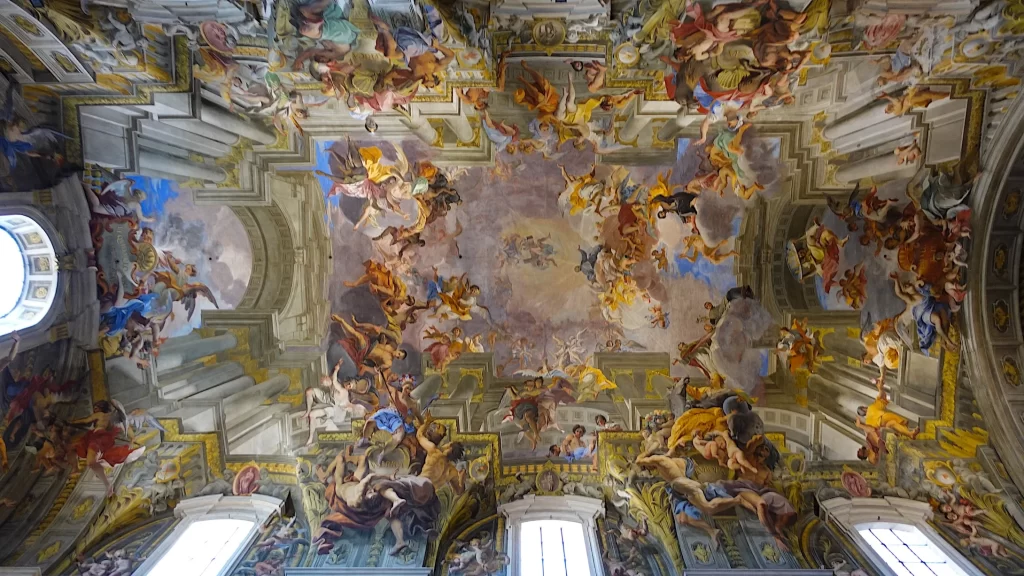
Now for the unusual presence of the mirror and the queue. Visitors can fully appreciate the fresco’s depth and complexity thanks to the strategically placed mirror. It allows for comfortable viewing without the need to crane one’s neck. There is lot in that painting to take in. The mirror not only enhances the visitor experience but also highlights the church’s commitment to making art accessible and engaging.
The Illusion of the Dome
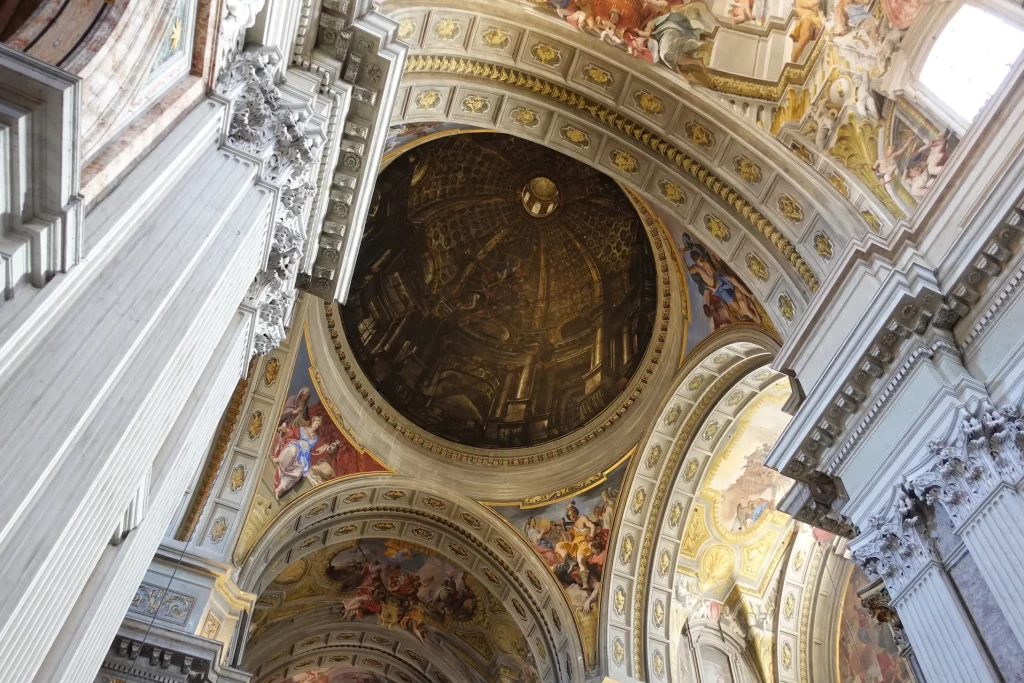
The absence of a real dome presented a challenge, but Pozzo turned this limitation into an opportunity for innovation. He painted a “false dome” on a flat canvas, 13 meters in diameter, affixed to the church’s ceiling. This trompe-l’oeil masterpiece creates the convincing illusion of a soaring dome. A visible only from specific vantage points marked on the church floor.
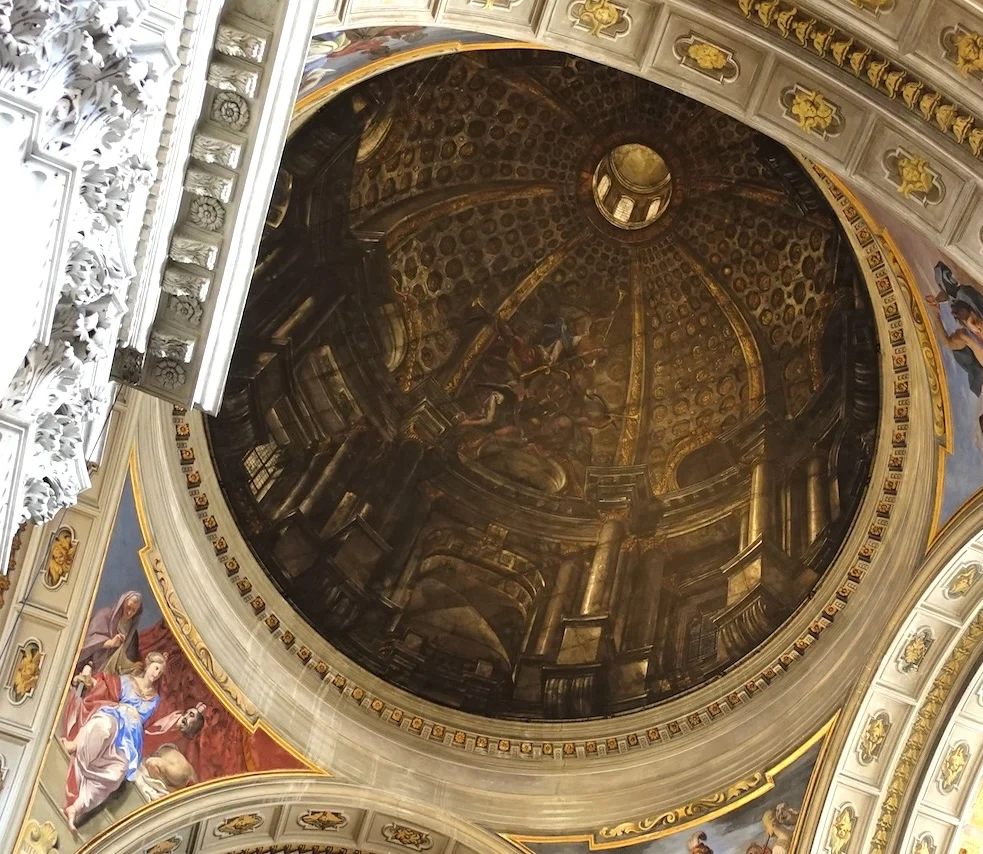
The original painting was tragically destroyed by fire in 1823. Artist Francesco Manno later recreated it using Pozzo’s original sketches and studies. Today, the illusion remains as striking as ever, a testament to the enduring power of artistic ingenuity.
Experiencing the Illusions Firsthand
Determined to experience Pozzo’s illusions in their full glory, I returned to the church early the next morning. Using the “magic mirror,” I marveled at the clarity and detail of the ceiling fresco. The sense of depth was so convincing that it was easy to forget the ceiling’s true, shallow profile.
As I explored further, I noticed a dark, circular patch on the ceiling—remnants of the false dome’s age and history. Moving to the left side of the church, I finally found the perfect spot where the illusion snapped into focus. From that vantage point, the painted dome appeared astonishingly real, a masterstroke of Baroque artistry.
It was only after returning home and reading more about the church that I learned about the floor markers, placed to guide visitors to the optimal viewing positions for both the fresco and the dome. This thoughtful detail underscores the church’s blend of artistic innovation and visitor engagement.
The Jesuit Legacy and Rome’s Overlooked Treasures
Sant’ Ignazio di Loyola was built at the direction of Pope Gregory XV, following the canonization of Ignatius of Loyola in 1622. While the church is a major Jesuit site, it is not the mother church of the Jesuit Order.
That honor belongs to the Church of the Gesù, located nearby at Piazza del Gesù. After completing his work at Sant’Ignazio, Pozzo continued his artistic contributions at the Gesù, further cementing his legacy within the Jesuit tradition.
A week after my return from Rome, I discovered that the Church of the Gesù was even closer to my hotel than I realized. I had walked past it several times, oblivious to the treasure hidden behind its walls. This revelation was a fitting reminder of Rome’s inexhaustible wealth of history and art. Much of it waiting to be discovered by those willing to wander off the beaten path.
Reflections on a Remarkable Encounter
The Church of Sant’Ignazio di Loyola is more than just an architectural curiosity. It is a celebration of creativity born from constraint, a showcase of Baroque artistry, and a testament to the enduring spirit of the Jesuit order. Its optical illusions are not mere artistic flourishes, but ingenious solutions to practical challenges—proof that limitations can inspire greatness.
For travelers seeking an authentic and awe-inspiring Roman experience, Sant’Ignazio offers a respite from the crowds. A chance to engage with art and history in an intimate, contemplative setting. Whether you are a lover of art, architecture, or simply the thrill of discovery, this church deserves a place on your Roman itinerary.
Practical Tips for Visiting
- Visit early in the morning or later in the evening to avoid crowds and fully appreciate the church’s serene atmosphere.
- Look for the floor markers to find the best vantage points for viewing the ceiling fresco and the false dome.
- Take advantage of the angled mirror to admire the intricate details of Pozzo’s masterpiece without straining your neck.
- Don’t forget to explore the Church of the Gesù for a deeper understanding of the Jesuit legacy in Rome.
Conclusion: Rome’s Endless Wonders
Rome is a city that rewards curiosity. Beyond its iconic landmarks lie countless hidden gems, each with its own story to tell. The Church of Sant’ Ignazio di Loyola is one such treasure. A place where art, history, and ingenuity converge to create an experience.
An experience that lingers long after you leave its hallowed halls. Next time you find yourself in the Eternal City, take a detour from the usual sights. Let Sant’Ignazio surprise you. You may just discover your own favorite corner of Rome.